
THE PHOTOGRAPH THAT CLAIMED ELVIS ESCAPED DEATH—AND THE QUESTION HISTORY STILL CANNOT BURY
Introduction
THE PHOTOGRAPH THAT CLAIMED ELVIS NEVER DIED: Why a 1979 Spain Mystery Still Haunts the Presley Legend
For nearly half a century, the accepted history of Elvis Presley has ended in the same place: Graceland, Memphis, on August 16, 1977. The world was told that the most recognizable entertainer of his generation had died at only 42, leaving behind a daughter, an unfinished career, and millions of admirers struggling to understand how a figure who had once appeared almost invincible could vanish so suddenly. His funeral became a moment of international mourning, and his death entered popular culture as one of music’s defining tragedies.
Yet famous deaths rarely remain untouched by speculation. The greater the legend, the more difficult some admirers find it to accept an ordinary ending. Elvis was not simply a successful singer. He had become a symbol of youth, rebellion, Southern identity, American ambition, and the transforming power of popular music. Because his image seemed larger than life, the idea of his death often felt emotionally impossible to those who had watched him reshape an era.
That disbelief has produced countless rumors over the decades. Some claimed he had been seen in airports, restaurants, hospitals, or isolated towns. Others suggested that he had entered a secret protection program, escaped dangerous associates, or abandoned fame to live quietly under another name. None of these stories has produced reliable evidence capable of overturning the documented historical record. Still, they continue to return because they speak to something deeper than fact: the public’s refusal to let Elvis Presley become entirely past tense.
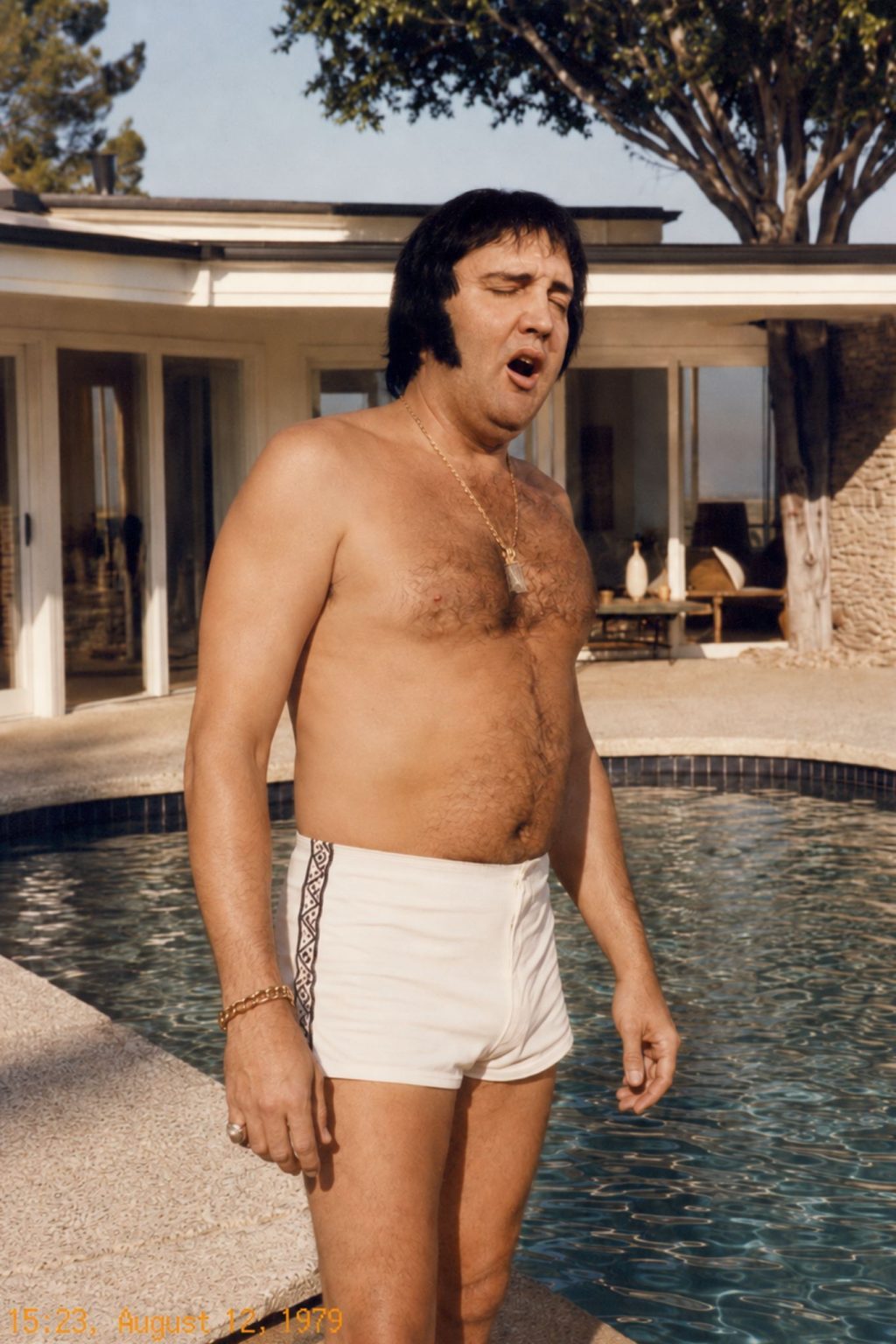
The latest version of this enduring mystery centers on an alleged photograph said to have been taken in Spain in 1979, two years after Elvis’s death. According to the speculative account, the image shows a dark-haired man swimming in the private pool of a secluded villa. He appears thinner than Elvis had been during his final public years, but supporters of the theory point toward the shape of his face, his hairline, posture, and physical movement as evidence that the man could be the supposedly deceased singer.

The story becomes even more dramatic when modern facial-recognition software is introduced. Claims of an extremely high probability match have circulated within the narrative, suggesting that technology has recognized what the human eye could only suspect. Additional photographs are then said to show the same man walking around the property, standing near its gate, and living without the entourage that had once surrounded Elvis everywhere he went.
These details create the perfect ingredients for a modern mystery. There is a famous dead man, a foreign villa, hidden photographs, computer analysis, and a suggestion that powerful people may have protected a secret for decades. Yet no independently authenticated archive, verified forensic report, official property record, or credible historical investigation has established that Elvis survived 1977 or lived in Spain afterward. Without such evidence, the Spain photograph remains a rumor, a piece of speculative storytelling, or at most an unidentified image onto which the Presley legend has been projected.
That distinction matters because emotional power is not the same as factual proof. A grainy photograph can resemble almost anyone when the viewer desperately wants recognition. Facial-comparison systems can also produce misleading results when working with low-resolution images, unusual angles, inconsistent lighting, or photographs taken decades apart. A percentage displayed on a screen may sound scientific, but without information about the software, source material, testing method, and independent review, it cannot responsibly be treated as confirmation.
Even so, the story raises fascinating questions about why Elvis conspiracy theories remain so compelling. One reason is that his final years were filled with visible contradiction. He remained capable of moments of extraordinary vocal power, but he also appeared physically exhausted and emotionally burdened. He continued performing before large audiences while living inside an increasingly restricted world shaped by illness, medication, professional obligation, and isolation.
To admirers, this created the image of a man trapped within his own fame. Elvis had achieved nearly everything a performer could desire, yet that success came with relentless expectations. He could not easily enter a public space, travel freely, or experience an ordinary day without being recognized. His home became both a sanctuary and a symbol of the life from which he could never fully escape.
Within that context, the idea of Spain becomes symbolic. It represents sunlight, distance, privacy, and a second life beyond the gates of Graceland. The imagined villa is not merely a hiding place; it is the freedom Elvis never seemed to possess while alive in public. In the conspiracy story, he does not escape because he hates his audience. He escapes because the identity called “Elvis Presley” has become impossible for the private man to survive.
That is why the alleged photographs are often described with such emotional detail. The man is not shown performing, smiling for cameras, or wearing a famous stage costume. He is swimming, walking, and standing alone. These ordinary actions become powerful because Elvis was rarely allowed to appear ordinary. The theory offers viewers an image of the life they wish he might have found: healthier, quieter, and removed from those who controlled his schedule and depended upon his fame.
The story also draws strength from longstanding public curiosity about Colonel Tom Parker, Elvis’s controversial manager. Parker exercised enormous influence over Elvis’s career and made decisions that have been debated for decades, particularly the absence of a major international concert tour. His complicated background and management practices provide conspiracy writers with a ready-made figure of suspicion.
In the Spain narrative, Parker is transformed from a demanding manager into an architect of escape, someone with access to hidden property, secret travel arrangements, and financial mechanisms capable of erasing the world’s most famous singer. It is an irresistible dramatic idea, but it remains unsupported by credible evidence. The presence of unanswered questions in a historical relationship does not automatically validate every theory later attached to it.
That ending is moving, but it should not be confused with established history. Until independently verified evidence emerges, the 1979 Spain image remains an unproven legend rather than a discovery that rewrites Elvis Presley’s death. Its value lies not in proving that he escaped, but in revealing why millions still wish he had.
Perhaps the real mystery is not whether Elvis survived beyond 1977. It is why, nearly fifty years later, the world remains emotionally unable to release him. His body may have left the stage, but his voice never did. It continues traveling through homes, radios, films, memorials, and generations born long after his final performance.
In that sense, Elvis Presley achieved something even more enduring than a secret life in Spain. He became impossible to bury in the human imagination.
Video
https://youtu.be/Afv2dcrjoAU