The Night the King Could Not Stop Her Leaving: Inside Elvis and Priscilla’s Quietest…
Introduction
The Night the King Could Not Stop Her Leaving: Inside Elvis and Priscilla’s Quietest Goodbye
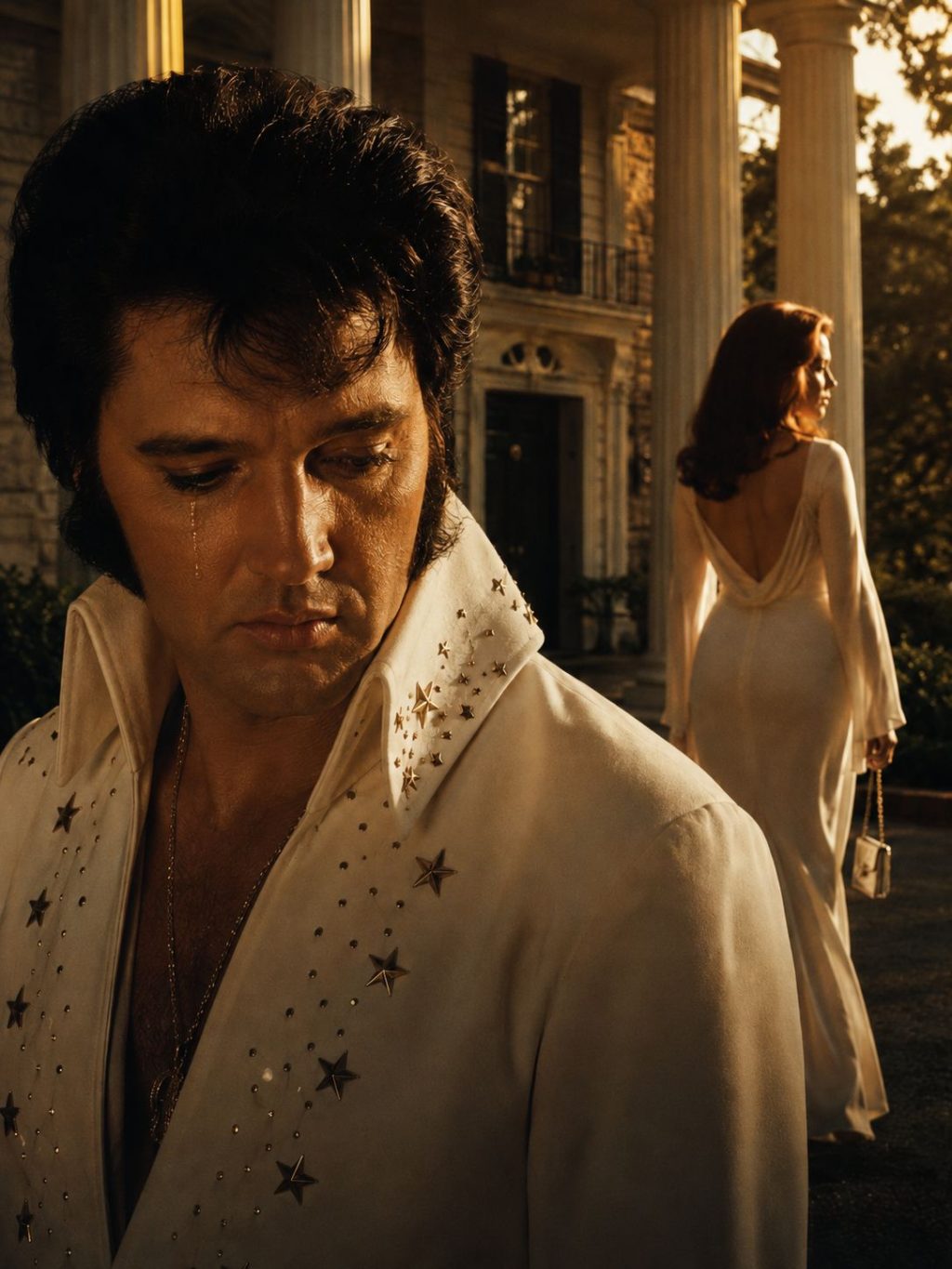
For millions of admirers, Elvis Presley and Priscilla Presley appeared to inhabit a world untouched by ordinary disappointment. Their photographs suggested elegance, youth, success, and a kind of romance that seemed perfectly suited to the grandeur of Graceland. He was the most recognizable entertainer of his generation, surrounded by sold-out performances and extraordinary public devotion. She stood beside him with remarkable composure, becoming part of an American story that newspapers, magazines, and fans followed with intense fascination. From a distance, their life together looked like a dream preserved beneath bright lights. Yet behind those memorable images was a marriage gradually being tested by distance, demanding schedules, loneliness, and the difficult realization that admiration from the world could not repair what was quietly changing at home.
The most heartbreaking chapter in their story was not defined by a single public argument or sensational announcement. It emerged through a slower and more painful understanding: Elvis could no longer hold on to Priscilla simply because he loved her. By the beginning of the 1970s, the two people who had once imagined a lasting future together were moving in different emotional directions. Elvis remained caught inside the immense machinery of fame, traveling, recording, rehearsing, and performing before audiences that expected greatness every night. Priscilla, meanwhile, was beginning to recognize her own need for independence, personal purpose, and a life that could not exist entirely within the shadow of her celebrated husband.
This is what makes their separation feel so deeply human. It is tempting to view famous marriages only through the dramatic language of scandal, betrayal, or public collapse. The truth is often quieter and more complicated. Two people may still care for one another while accepting that the life they have built no longer allows either of them to flourish. Affection does not always disappear when a marriage ends. Sometimes it remains present, making the decision to separate even more painful. In the case of Elvis and Priscilla, their final years as husband and wife carried precisely that sense of emotional contradiction: tenderness mixed with disappointment, loyalty complicated by absence, and love forced to confront realities it could no longer overcome.
For Elvis, this recognition must have been especially difficult. Onstage, he possessed extraordinary authority. A movement of his hand could send excitement through an entire arena. A quiet phrase could hold thousands of listeners in complete attention. His voice communicated confidence, vulnerability, hope, sorrow, and spiritual longing with an immediacy few performers could equal. Yet the control he exercised in performance could not be transferred to his private life. He could command a stage, but he could not command another person’s heart or determine the direction of her future.
That distinction may be the most painful truth at the center of this story. The King of Rock and Roll, adored by millions, encountered a loss that fame could not prevent. No standing ovation could postpone the conversation. No record sales could restore the closeness that had faded between them. No entourage could protect him from the private knowledge that Priscilla had reached a decision formed over years of emotional isolation and personal growth. The man the world considered powerful was suddenly confronted by an experience familiar to countless ordinary people: the moment when someone deeply loved chooses to leave.
The exact words exchanged during the most private conversations between Elvis and Priscilla belong to them, and any responsible reflection should resist turning those intimate moments into invented dialogue. What matters is the emotional meaning carried by the decision they ultimately made. Their separation communicated something more painful than anger: it acknowledged that the marriage could not continue in its existing form. They had reached a point where holding on might have caused greater harm than letting go.
Their daughter, Lisa Marie Presley, gave the former couple an enduring bond that continued beyond the legal end of their marriage. Whatever difficulties existed between them, both remained connected through their love for her. This part of the story is important because it prevents their separation from being reduced to a simple tale of victory and defeat. There was no true winner. A family changed, a shared dream ended, and two people carried the consequences in different ways. Yet they also attempted to preserve respect and a sense of family responsibility after the marriage was over.

When their divorce was finalized, the public saw images of Elvis and Priscilla leaving together with dignity. Those photographs have endured because they do not resemble the bitter conclusion many expected. Instead, they suggest mutual affection surviving the end of a marriage. They remind us that a relationship can fail in one form while retaining meaning in another. Elvis and Priscilla were no longer husband and wife, but the years they shared could not simply be erased. Their history remained present in memories, in Lisa Marie, and in the emotional connection that had once brought them together.
For older readers who remember Elvis during his lifetime, this chapter reveals something that the dazzling stage costumes and triumphant performances could never fully show. Beneath the celebrated image was a man who struggled with loneliness, insecurity, and the fear of losing those closest to him. His emotional life was not protected by fame; in many ways, fame made genuine closeness more difficult. Constant attention could fill an arena while leaving a home painfully quiet. Public love could surround him without providing the stability of an ordinary family life.
Priscilla’s decision also deserves to be understood as more than a departure from a famous husband. It represented a woman’s attempt to establish an identity of her own after spending formative years within the gravitational force of an international icon. Leaving did not necessarily mean that she had stopped caring. It meant that affection alone was no longer sufficient to answer the questions she faced about independence, adulthood, and personal direction. Her choice was painful because it required her to walk away not only from a marriage, but from a world that millions regarded with envy.
The tragedy of Elvis and Priscilla’s final goodbye therefore lies not in the disappearance of love, but in love’s inability to preserve the life they once imagined. Elvis had conquered stages, transformed popular music, and become a symbol recognized around the world. Yet in the quietest rooms of Graceland, he learned that even a king cannot prevent change. Sometimes the most courageous act is not holding someone more tightly, but accepting that the person must be allowed to go.
That realization changed everything. It revealed the vulnerable man beneath the legend and transformed a glamorous public romance into a timeless story of regret, maturity, and emotional surrender. Long after the applause has faded, this remains one of the most affecting truths in the Elvis story: the world belonged to him for a moment, but the future of the woman he loved did not.