THE NIGHT ROD STEWART STOPPED A CELEBRATION—AND SANG BONNIE TYLER’S FINAL GOODBYE
Introduction
THE NIGHT THE CELEBRATION FELL SILENT: Rod Stewart’s Heartbreaking Final Song for Bonnie Tyler
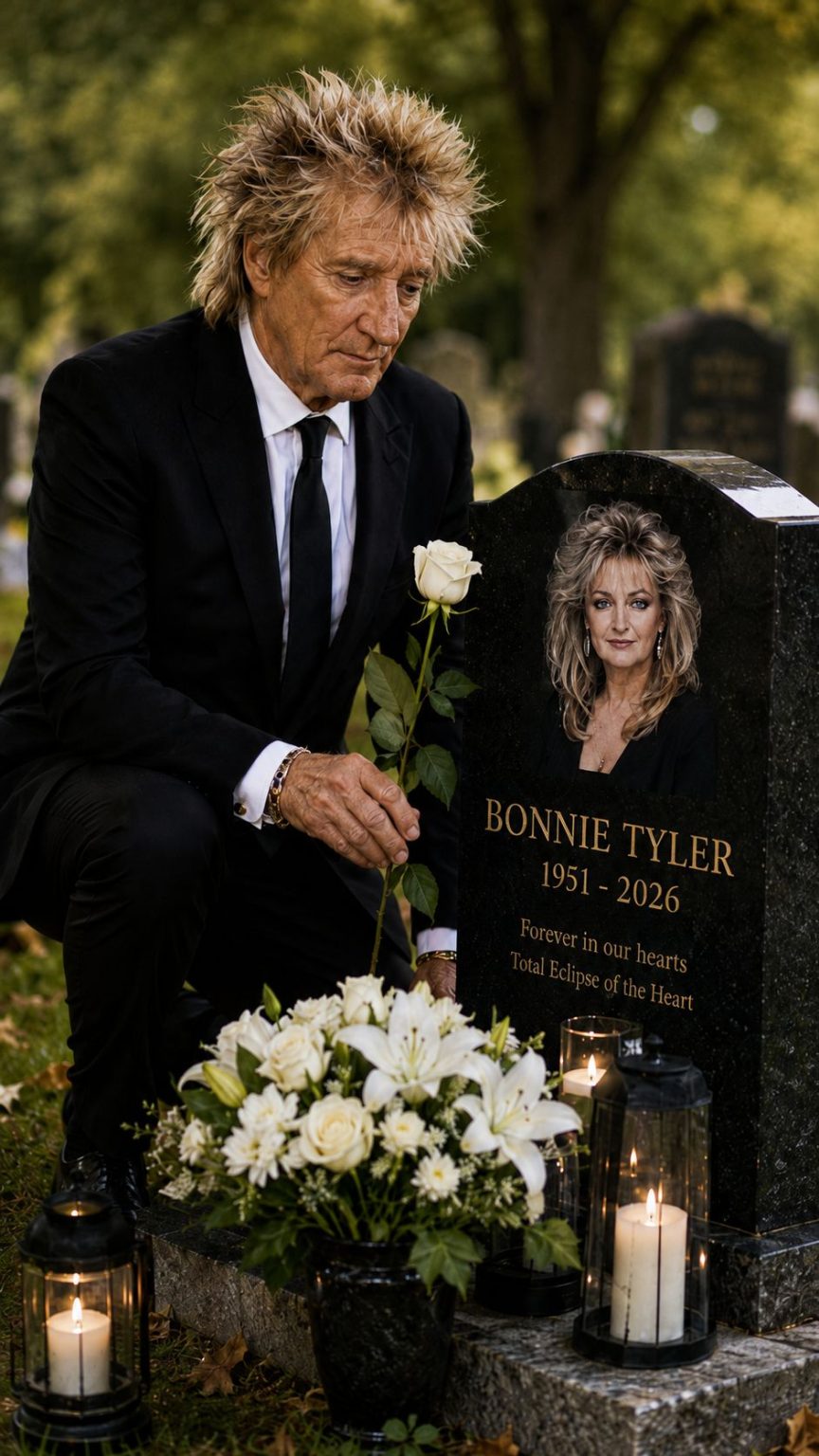
The elegant gathering at Gleneagles Hotel was meant to celebrate endurance, generosity, and fifty years of charitable achievement. Distinguished guests had assembled in Perthshire for an anniversary event supporting The King’s Trust, while Jools Holland waited at the piano and the room anticipated an evening of warmth and familiar music. Then Rod Stewart stepped forward carrying news that instantly changed the atmosphere. Bonnie Tyler had died the previous night in Portugal at the age of 75, and the celebration was about to become something far more solemn: an unplanned farewell to one of Britain’s most distinctive voices.
There was no elaborate memorial production and no carefully rehearsed tribute prepared weeks in advance. The loss was still painfully recent when Stewart addressed the gathering on July 9, 2026. He spoke of Tyler as a cherished friend and a performer whose voice could stir the soul. With Holland accompanying him, Stewart began singing “It’s a Heartache,” the song that had carried Tyler’s unmistakable sound around the world nearly half a century earlier. The performance became the emotional center of the evening, not because it was technically perfect, but because it arrived before grief had been arranged into polished language.
Rod Stewart’s voice has always carried the marks of experience. Its weathered texture, emotional directness, and refusal to sound overly refined made him a natural interpreter of Tyler’s music. Long before that evening at Gleneagles, listeners had often compared the two singers because both understood how to transform vocal roughness into emotional authority. Neither voice needed conventional smoothness to communicate truth. Each sounded as though joy, disappointment, endurance, and memory had passed through it before reaching the microphone.

That similarity made Stewart’s choice especially meaningful. He was not simply selecting Tyler’s most convenient song for the occasion. “It’s a Heartache” had been part of his own concert repertoire, and it belonged naturally within the expressive world of his voice. Yet at Gleneagles, the familiar words carried an entirely different weight. What had once been a song about disappointment became a public message to the woman who had first made it unforgettable.
Released in 1977, “It’s a Heartache” reached No. 4 on the UK Singles Chart and remained in the Top 10 for seven weeks. It introduced a much wider audience to a Welsh singer whose voice seemed instantly recognizable, even to people hearing it for the first time. The recording did not depend upon fashionable production or excessive display. Its power came from Tyler’s ability to make a straightforward lyric sound deeply personal, as though she were sharing an experience rather than merely performing a composition.
When Stewart sang it after her death, listeners were hearing two histories at once. They heard the original memory of Bonnie Tyler, young and determined, announcing herself to the international music world. They also heard an older friend acknowledging that her journey had reached its end. The passing years stood silently between those two versions of the song, turning a well-known chorus into a reflection on friendship, mortality, and the difficult responsibility of continuing after someone important is gone.
Tyler’s journey had begun far from the grandeur of international stages. Born Gaynor Hopkins in Skewen, South Wales, she grew up in a working family and developed her craft in local clubs before entering the recording industry. Her rise was built through persistence rather than certainty. She did not arrive with a carefully manufactured image designed to guarantee success. She arrived with determination, an instinct for powerful material, and a voice that sounded completely unlike the voices surrounding it.
Her vocal character became even more distinctive following surgery on her vocal cords during the 1970s. The resulting husky quality might have been regarded as an obstacle in an industry often obsessed with polish, yet Tyler transformed it into her defining strength. Her voice could sound wounded without becoming weak and forceful without losing tenderness. It carried the rare ability to suggest that courage and vulnerability were not opposites, but two parts of the same human experience.
That gift reached its most celebrated expression in “Total Eclipse of the Heart.” Written and produced by Jim Steinman, the song demanded enormous emotional commitment, dramatic control, and the courage to enter a musical landscape larger than ordinary pop. Tyler did not disappear beneath its sweeping arrangement. She rose to meet it, making every change in intensity feel necessary. The recording reached No. 1 in the United Kingdom, while its parent album, Faster Than the Speed of Night, also topped the UK albums chart.
For many artists, one achievement of that scale might have become impossible to escape. Tyler, however, continued building a career around more than one famous recording. “Holding Out for a Hero” became another enduring anthem, finding repeated life through film, television, sporting events, and new generations of listeners. Her music survived because it was never embarrassed by strong emotion. She sang as though ordinary restraint was sometimes insufficient, especially when the heart was carrying more than conversation could express.
Tyler also refused to become merely a preserved figure from the 1980s. She continued recording and touring across Europe, represented the United Kingdom at the 2013 Eurovision Song Contest, and released The Best Is Yet to Come in 2021. Her later career demonstrated that devoted listeners did not regard her simply as a memory. They continued attending because the voice remained real, the personality remained warm, and the songs still provided a place where powerful feelings could be expressed without apology.
Her connection with Stewart extended beyond their similar vocal character. Rod Stewart contributed to Tyler’s 2019 album, Between the Earth and the Stars, an album that also featured other distinguished figures from British music. Their professional association strengthened a friendship that became publicly visible in Stewart’s words after her passing. When he described Tyler as someone capable of stirring the soul, he was speaking not as a distant admirer, but as a fellow performer who understood the discipline required to sustain a recognizable voice across changing decades.
The final period of Tyler’s life had brought concern to her family and admirers. She underwent emergency intestinal surgery in Portugal and spent time receiving intensive hospital treatment. Official updates initially carried cautious hope, which made the announcement of her unexpected death especially difficult for followers who had been waiting for encouraging news. Her family and team confirmed her passing through her official channels on July 9, 2026, prompting tributes from musicians, actors, and listeners around the world.
Against that background, Stewart’s performance at Gleneagles becomes even more affecting. He walked into a room prepared to honor a charitable institution, yet found himself carrying the emotional responsibility of announcing that a friend was gone. There was no time to create distance from the news. He could only turn toward the instrument, trust the song, and allow music to speak where an extended speech might have failed.
“It’s a Heartache” became a farewell because Rod Stewart understood that some losses are too immediate for eloquence. His rough-edged delivery did not conceal the sadness; it gave the sadness somewhere to live. Holland’s piano provided structure, but the emotional meaning came from the knowledge that Tyler would never again stand before an audience and deliver the song in the voice that had made it famous.
For older listeners, the moment carries a meaning that reaches beyond celebrity. It speaks to the experience of watching familiar voices gradually disappear from the world. The performers who once seemed permanently present become part of history, leaving songs behind as evidence that their lives once intersected with ours. A record heard in youth may eventually become a memorial, not because the music has changed, but because the listener now understands how much time has passed.
Bonnie Tyler’s legacy cannot be reduced to one anthem, one decade, or one dramatic vocal performance. It lives in the authority she gave to an unconventional voice, in her refusal to soften the qualities that made her unique, and in the courage with which she continued performing long after changing fashions had moved elsewhere. Her music taught listeners that emotional strength does not always sound polished. Sometimes it arrives weathered, imperfect, and entirely unforgettable.
Rod Stewart did not enter Gleneagles expecting to sing a final goodbye. Yet before the evening ended, a charitable celebration had become a scene of collective remembrance. One famous voice honored another, not through spectacle, but through friendship and a song they both understood.
The applause that followed could not bring Bonnie Tyler back. It could only acknowledge what she had given and what had suddenly been lost. Nevertheless, for several quiet minutes, Rod Stewart, Jools Holland, and “It’s a Heartache” created a bridge between grief and gratitude. The room had gathered to celebrate fifty years of service, but it left carrying another memory: the night a familiar song became a farewell, and one enduring British voice helped the world say goodbye to another.